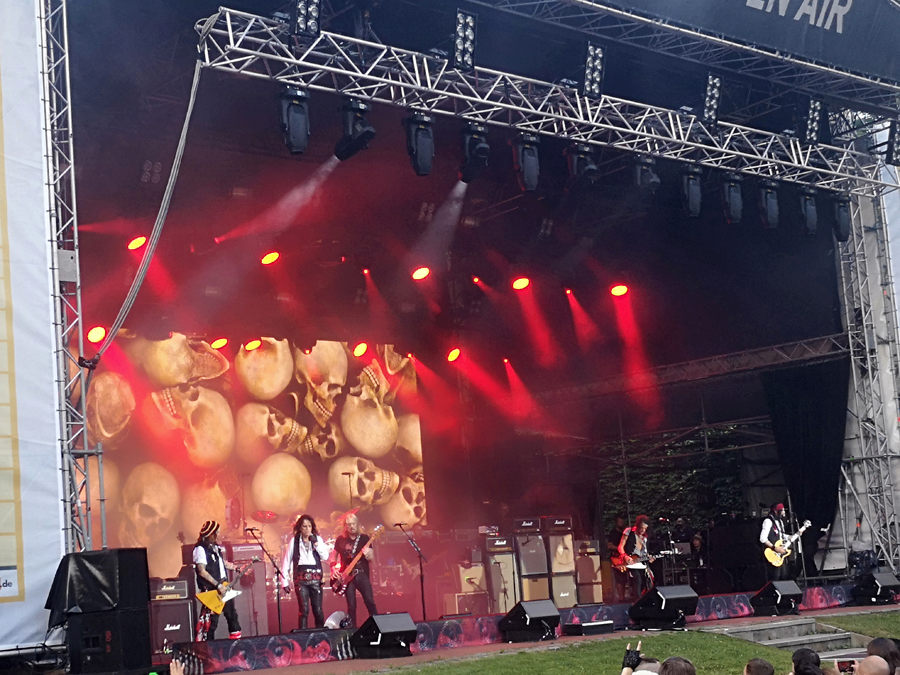
„Essentially a pub rock supergroup that grew monstrously out of control“ (list.co.uk). Alice Cooper, Johnny Depp, dagegen verblasst doch vieles. Die beiden so nah: so real, daß es surreal ist. Johnny bester Laune, hatte sich offenbar den Knöchel gebrochen und stapft mit Fraktur-Boot über die Bühne, singt aber göttlich und hat eine gute Zeit, smiling and waving and looking so fine. „The Death & Resurrection Show“, das Killing Joke-Cover von seiner Platte mit Jeff Beck, ist eine der Glanznummern der ausgelassenen Vampire an diesem Abend. Bei allem Heidenspaß geht es bei den Hollywood Vampires immer auch um absent friends, verlorene Weggefährten, und Johnny hat eine Gitarre seines jüngst verstorbenen Freundes Jeff Beck dabei. Die spielt Joe Perry dann für ein Stück. Da wird einem gleich ums Herz so doof. Überhaupt Perry: Aerosmith leidet ja vor allem unter Steven Tyler, Perrys Cover von „You Can’t Put Your Arms Around A Memory“ zeigt, daß er eigentlich der viel bessere Sänger ist, seine Stimme wie gemacht für diesen Song von Johnny Thunders.
And that Cooper woman… der ist 75 und kontrolliert immer noch die Erdrotation mit seinem Stock. „School’s Out“ und „Billion Dollar Babies“ gehörten zu den ersten Platten, die ich als Schuljunge besaß. Ich sag’s nur. Charisma-Overkill. „Listen to them. The children of the night. What music they make!“
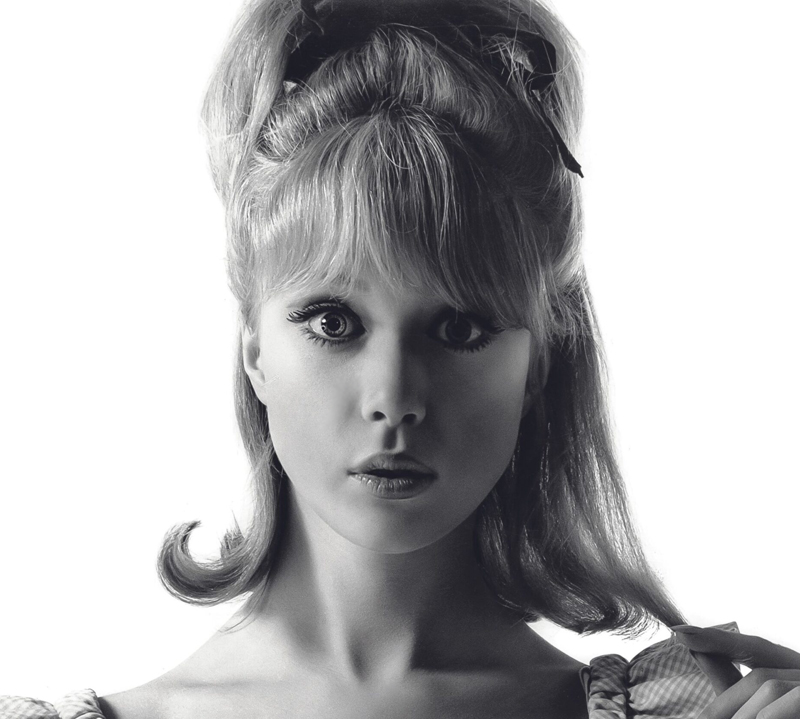
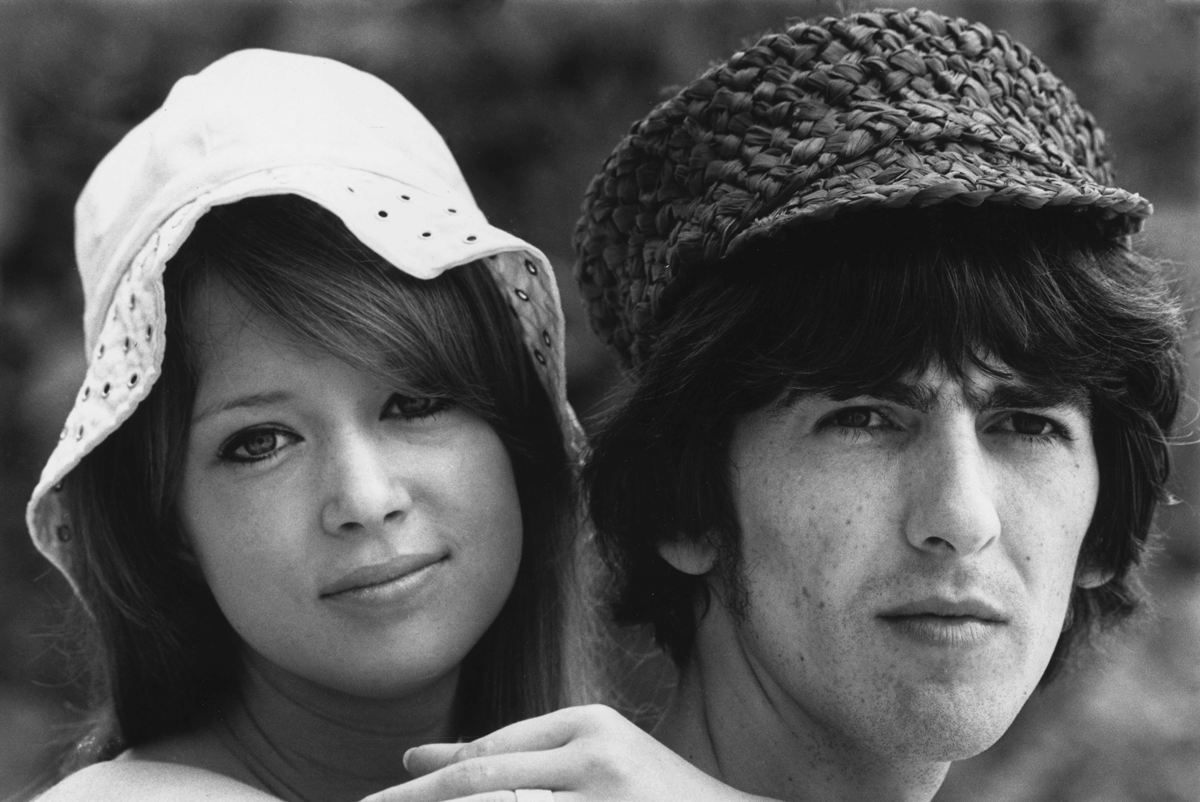
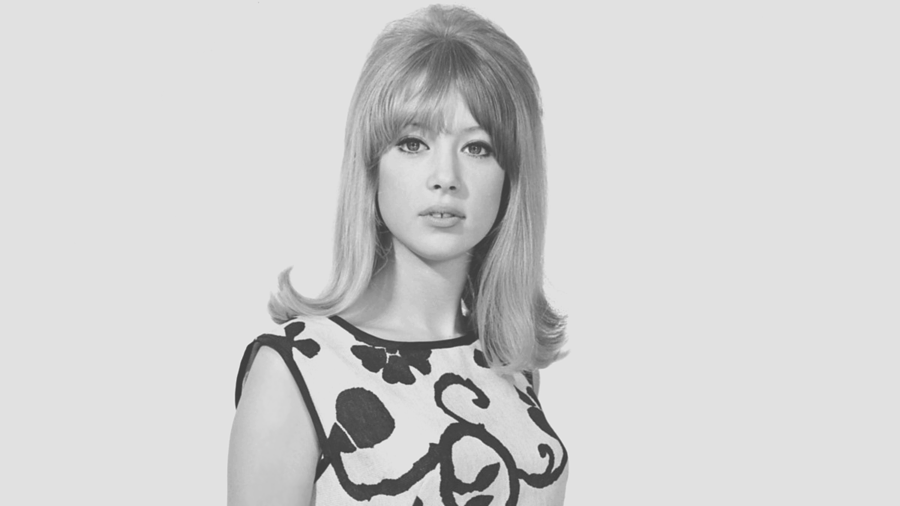
Pattie Boyd has slammed today’s youth for being ‚woke‘ and ‚oversensitive‘, adding that she misses her heyday in the ‚totally free‘ Swinging Sixties.
The model, 78, claimed the snowflake youths have stolen her hard-won freedoms, adding that she finds the change in attitude to be ‚odd‘.
She said: ‚Everybody’s so different, particularly young people now. You know, they’re woke and over-sensitive about everything. And I thought, „How odd.“
‚I feel that there’s been a huge cycle, because in the 1960s we broke away. We wanted freedom, we fought for it, and we wore outrageous clothes and short dresses.
‚Artists painted outrageous things, filmmakers started being totally free. Here was a freedom suddenly.
‚I feel that cycle is now coming to an end. The freedom has been taken away. It’s the opposite of the 1960s, when we were brave and we could say and do anything.‘
Zuerst schrieb mir die Marketing-Abteilung von BoD. Vito von Eichborn, einer der innovativsten Buchmacher Deutschlands, betätige sich als Herausgeber einer Edition für BoD und wäre erfreut, meinen Roman in diese Edition aufnehmen zu können. Zu diesem Zeitpunkt war „Aljoscha der Idiot“ fast zwei Jahre auf dem „Markt“ – jenem Markt, von dem mir der Lektor eines renommierten Verlags gesagt hatte, ein Roman wie dieser sei dort „nicht durchsetzbar“. Ich hatte mich dann für das System Books on Demand entschieden, „Aljoscha“ also auf eigene Faust veröffentlicht, ich hatte die Erlaubnis der Erben des berühmten Frans Masereel, einen seiner Holzschnitte für das Cover verwenden zu dürfen, ich hatte all das mit Freuden bezahlt, und dummerweise hing ich nun sehr an der Art, wie dieses Werk in die Welt gekommen war. Und darauf schrieb mir dann Vito von Eichborn selbst.
Lieber Autor, schrieb er, oje, das habe er befürchtet: jemand, der so schreiben kann, hat absolut seinen eigenen Kopf. „Ihr Buch ist für mich der so seltene klassische Fall: grandios gut und absolut schwer verkäuflich. Dies ist für mich der erste Fall, in dem die literarischen Verlage offensichtlich versagt haben.“ Die Edition, schrieb er, habe ein festes Gestaltungsprinzip, aber er wolle dafür sorgen, daß wir den Masereel-Holzschnitt mitnehmen. Mit der ihm eigenen Machen-wir-uns-nichts-vor-Haltung sagte er mir: machen wir uns nichts vor, BoD kommt in den Feuilletons nicht vor, keine Versprechungen, aber: „Ihr Buch ist eine ganz seltene Perle“, und vielleicht könne seine Stimme mehr Menschen zum Lesen bringen.
Er schrieb ein Vorwort für die Neuausgabe, und wenn einer wie er sagt, dieser Roman sei „literarisch das Beste, was ich in den letzten Jahren gelesen habe“, hat das sehr große Bedeutung für einen, der tausend Nächte tief daran gearbeitet hat, ohne zu wissen, ob dieser Balg je Hosen trägt. Es war bezaubernd zu hören, wie er dann auf der Leipziger Buchmesse in einem Radio-Interview von „Aljoscha“ schwärmte – wenn man die Begeisterung eines mit allen Wassern Gewaschenen so nennen darf.
Seine Emails waren immer wie kleine Stromstöße, und in einer der letzten, die ich von ihm erhielt damals, stand: „Wenn jemand schreiben muß, dann Sie!“
Gute Reise, lieber Vito von Eichborn. Danke für die Neugier, für den Enthusiasmus, für den Mut. Danke für alles.
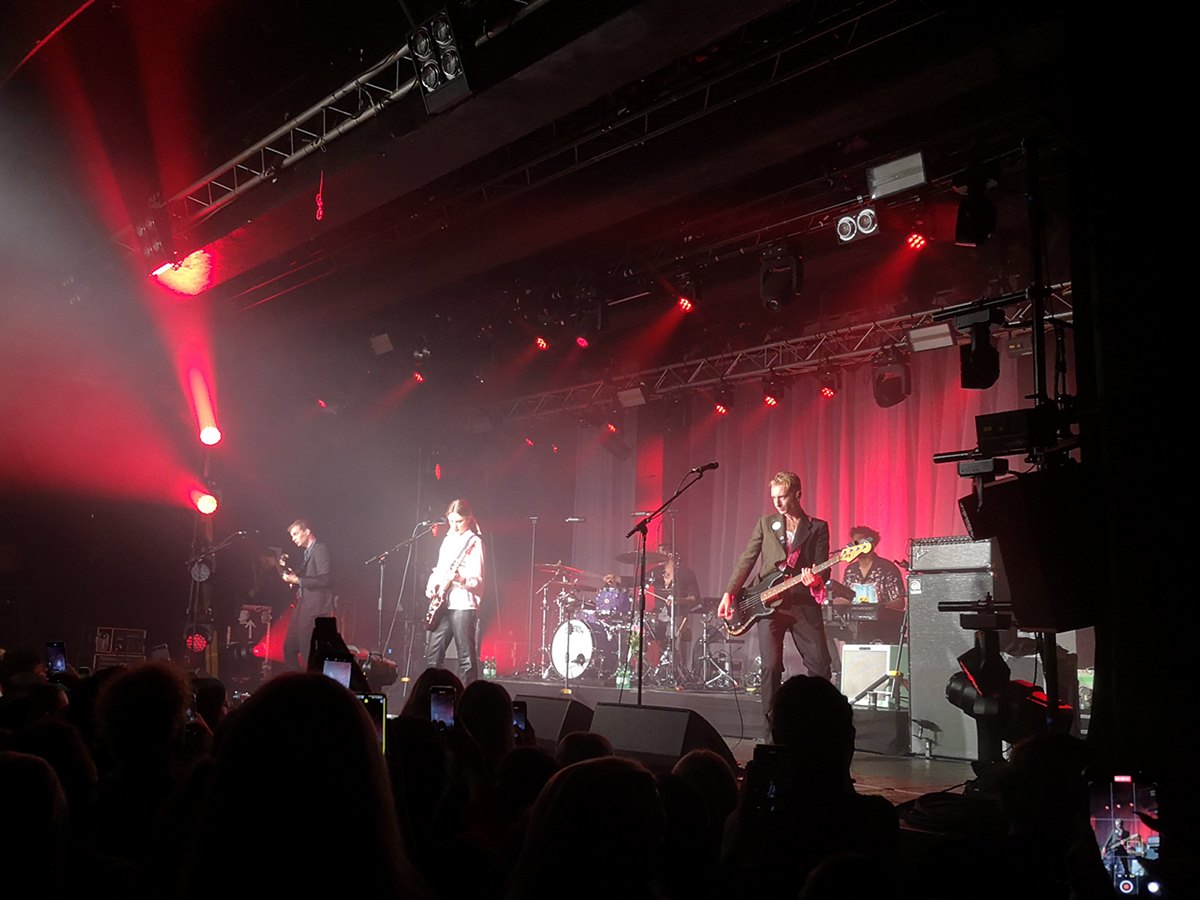
Wolf Alice so sensationell wie sympathisch, die Band überwältigt von der Euphorie im Haus und so ging der Abend irgendwann durchs Dach. Hatte nicht erwartet, daß sie in einem solchen Sturm der Liebe stehen würden. Rote Rosen, BHs, alle Arten von Allem landeten auf der Bühne. Eine Band, wie es irgendwie schon länger keine Band mehr gab.
Ich half Lord Byron, eine bestimmte Frau zu finden. Wir fanden sie in einem Spielsalon an einem Roulette-Tisch. Ich begann ein Gespräch mit ihr. Ich mußte herausfinden, ob sie Tale of a Vampire kennt. Das war das Kriterium. Lord Byron spielte inzwischen Billard am Ex-Roulette-Tisch. Die Frau kannte den Film. Und sie hatte das Buch schon besessen, bevor es den Film dazu gab. Ich beugte mich zu Lord Byron und flüsterte: „Vor dem Film!“
Die Sache war geklärt. Das große Bett, Ex-Billard-Tisch, wir lagen zu dritt darin.
The skies they were ashen and sober; The leaves they were crispéd and sere — The leaves they were withering and sere: It was night, in the lonesome October Of my most immemorial year: It was hard by the dim lake of Auber, In the misty mid region of Weir: — It was down by the dank tarn of Auber, In the ghoul-haunted woodland of Weir.
Here once, through an alley Titanic, Of cypress, I roamed with my Soul — Of cypress, with Psyche, my Soul. These were days when my heart was volcanic As the scoriac rivers that roll — As the lavas that restlessly roll Their sulphurous currents down Yaanek, In the ultimate climes of the Pole — That groan as they roll down Mount Yaanek In the realms of the Boreal Pole.
Our talk had been serious and sober, But our thoughts they were palsied and sere — Our memories were treacherous and sere; For we knew not the month was October, And we marked not the night of the year — (Ah, night of all nights in the year!) We noted not the dim lake of Auber, (Though once we had journeyed down here) We remembered not the dank tarn of Auber, Nor the ghoul-haunted woodland of Weir.
And now, as the night was senescent, And star-dials pointed to morn — As the star-dials hinted of morn — At the end of our path a liquescent And nebulous lustre was born, Out of which a miraculous crescent Arose with a duplicate horn — Astarte’s bediamonded crescent, Distinct with its duplicate horn.
And I said — „She is warmer than Dian; She rolls through an ether of sighs — She revels in a region of sighs. She has seen that the tears are not dry on These cheeks where the worm never dies, And has come past the stars of the Lion, To point us the path to the skies — To the Lethean peace of the skies — Come up, in despite of the Lion, To shine on us with her bright eyes — Come up, through the lair of the Lion, With love in her luminous eyes.“
But Psyche, uplifting her finger, Said — „Sadly this star I mistrust — Her pallor I strangely mistrust — Ah, hasten! — ah, let us not linger! Ah, fly! — let us fly! — for we must.“ In terror she spoke; letting sink her Wings till they trailed in the dust — In agony sobbed; letting sink her Plumes till they trailed in the dust — Till they sorrowfully trailed in the dust.
I replied — „This is nothing but dreaming. Let us on, by this tremulous light! Let us bathe in this crystalline light! Its Sybillic splendor is beaming With Hope and in Beauty to-night — See! — it flickers up the sky through the night! Ah, we safely may trust to its gleaming, And be sure it will lead us aright — We safely may trust to a gleaming That cannot but guide us aright Since it flickers up to Heaven through the night.“
Thus I pacified Psyche and kissed her, And tempted her out of her gloom — And conquered her scruples and gloom; And we passed to the end of the vista — But were stopped by the door of a tomb — By the door of a legended tomb: — And I said — „What is written, sweet sister, On the door of this legended tomb?“ She replied — „Ulalume — Ulalume — ‚T is the vault of thy lost Ulalume!“
Then my heart it grew ashen and sober As the leaves that were crispéd and sere — As the leaves that were withering and sere — And I cried — „It was surely October, On this very night of last year, That I journeyed — I journeyed down here! — That I brought a dread burden down here — On this night, of all nights in the year, Ah, what demon has tempted me here? Well I know, now, this dim lake of Auber — This misty mid region of Weir: — Well I know, now, this dank tarn of Auber — This ghoul-haunted woodland of Weir.“
Said we, then, — the two, then, — „Ah, can it Have been that the woodlandish ghouls — The pitiful, the merciful ghouls, To bar up our way and to ban it From the secret that lies in these wolds — From the thing that lies hidden in these wolds — Have drawn up the spectre of a planet From the limbo of lunary souls — This sinfully scintillant planet From the Hell of the planetary souls?“
„Ulalume“ by Edgar Allan Poe, 1847
Pic from „Ulalume“ by Nestore Buonafede, 2009
„Ulalume“ by Jeff Buckley: „Closed on Account of Rabies“, Poemes and Tales of Edgar Allan Poe, 1997








 Das Cabinet des Christian Erdmann